

Fully Booked Is a Warning Sign
Fully Booked Is a Warning Sign: Occupancy, Rate, and What Your Calendar Is Telling You
"We’re booked solid" is the sentence owners most like to say and the one revenue managers most like to question. A calendar with no white space feels like success. Often it is the opposite: the clearest sign a home is priced below what guests were willing to pay. Every night that sold instantly is a night that could have sold for more, and every extra guest night carries costs of its own.
This post is a diagnostic. It explains the three numbers that describe a rental’s performance, why 100% occupancy is a symptom rather than a goal, how to read booking pace in Killington and on the Maine coast, and what a revenue manager does instead of filling the calendar.
The Quick Answer
Occupancy is the share of available nights that sold. Average daily rate (ADR) is what each sold night earned. Revenue per available night (RevPAN, or RevPAR in hotel terms) multiplies the two and is the number that pays the mortgage. Industry pricing benchmarks treat 90% to 100% occupancy as a sign the home is likely underpriced, and 70% to 85% as a healthy balance for most markets. The goal is not to maximize occupancy. It is to maximize revenue per available night, which sometimes means leaving a night empty rather than selling it below what it’s worth.

A full calendar answers one question and raises a better one.
The three numbers, in plain English
Occupancy rate is nights booked divided by nights available. A home available 30 nights that books 27 ran 90% occupancy. Owner blocks come out of the "available" count, so a month you used for a week yourself can’t hit 100% anyway.
Average daily rate (ADR) is total rental revenue divided by nights booked. If those 27 nights earned $5,400, the ADR was $200.
Revenue per available night (RevPAN) is total revenue divided by nights available, or ADR times occupancy. In the example, $5,400 across 30 available nights is $180 a night. RevPAN is the number to watch because it punishes both failures at once: an empty calendar and a full one sold cheap.
The arithmetic that surprises owners: a home at 50% occupancy and a $400 ADR earns the same revenue per available night as a home at 100% occupancy and a $200 ADR. The first home hosted half as many guests, ran half as many turnovers, and took half the wear to get there.
Why 100% is a symptom
Price is a signal in both directions. A night that nobody books at your rate is overpriced for that night. A night that books the moment it opens, months out, with multiple inquiries behind it, was underpriced. The second kind of mistake is quieter because it never shows up as an empty date. It shows up as a full calendar and a revenue number that is lower than it should be.
Pricing benchmarks used across the industry read an occupancy range of 90% to 100% as "likely underpriced, raise rates," and 70% to 85% as a healthy equilibrium to maintain. Those are portfolio averages, and the right number for your home depends on the market and the season. A Killington ski house should run near full on holiday weeks and a Wells cottage should run near full in July and August. The warning sign is a home that is near full in the shoulder months too, or that sold its peak weeks before the market had even formed a price for them.
GetAway’s approach, in the words of our owner site, is to earn revenue through intelligent pricing rather than the highest possible rate on any single night. That cuts both ways. It means not gouging a last-minute guest, and it means not giving away Presidents’ Week in October because a full calendar felt good.
Same revenue, different calendar
The three homes below each earned $48,000 in a year, with the same average stay of three nights. The numbers are illustrative, not drawn from any GetAway property.
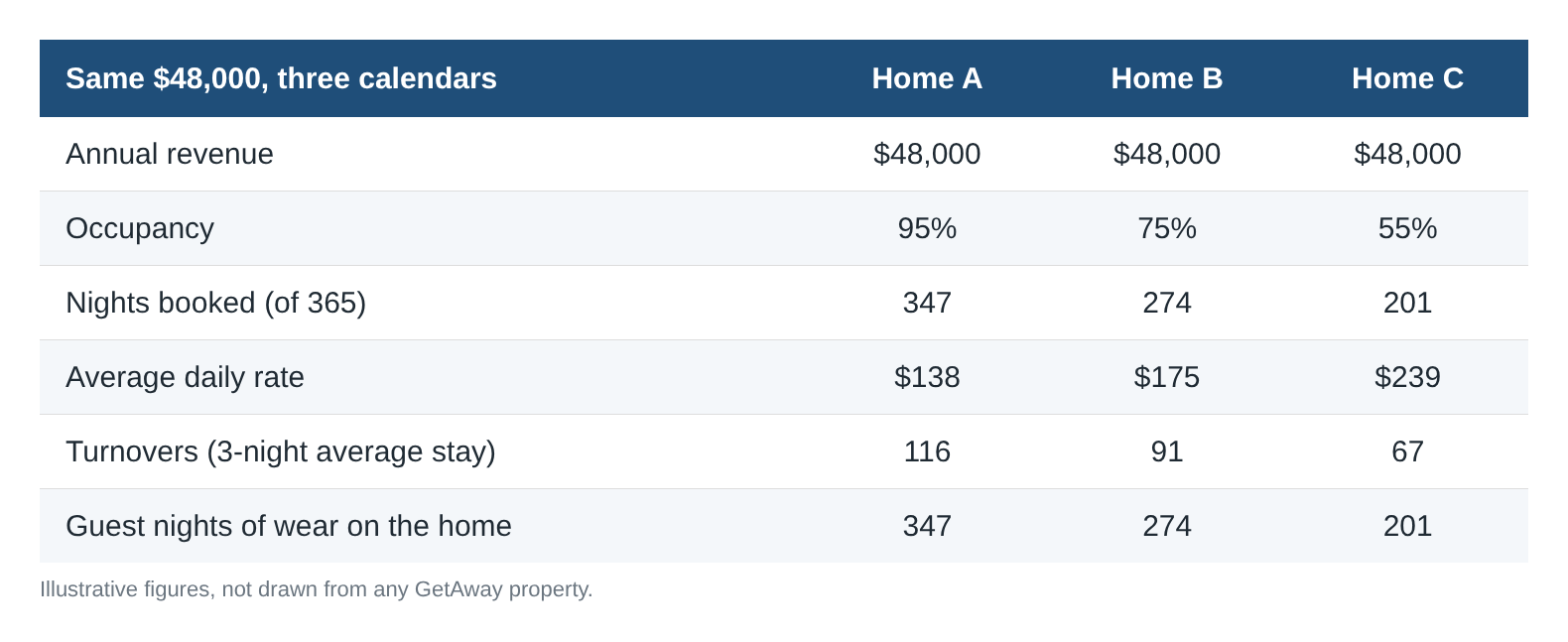
Home A’s owner probably told friends the house was "always booked." Home C’s owner earned the same money with 146 fewer guest nights, 49 fewer turnovers, and far more weeks available for their own use or for maintenance. Raising Home A’s rates toward Home C’s would have kept the same revenue with far less wear, and a revenue manager watching pace would likely find more.
None of this says low occupancy is good. A home at 40% occupancy because its rates are too high is leaving money on the table from the other side. It says occupancy alone tells you nothing until you put the rate next to it.
The booking-pace test for Killington and the Maine coast
Booking pace is how far in advance your nights sell, and it’s the most useful early warning you have. Five questions:
Did your peak weeks sell out before the market priced them? In Killington that means Christmas week, Presidents’ Week, and the Killington Cup weekend; on the coast it means the July and August weeks. If those sold out many months ahead with no rate movement, they sold cheap.
Are you booked every weekend of the season before the season starts? Weekend demand in ski country and on the beach is deep. Selling all of it early, at one rate, skips the guests who would have paid more closer in.
Do you ever turn down a request? A home that never says no to a date or a stay length is not being priced; it’s being filled.
Do reviews mention value more than the home? "Great deal" and "incredible price" in your reviews are compliments to your rate, not your house.
Is the calendar full but revenue flat? If occupancy stayed high while revenue didn’t grow, rates didn’t move with the market.
Three or more yes answers is a pricing conversation, not a victory lap.

The calendar should look uneven. Demand is.
The hidden cost of every extra night
Occupancy isn’t free. Each additional guest night brings:
A turnover, eventually. Even where the cleaning fee is paid by the guest, each turnover is a window for something to be missed, a linen cycle, and a scheduling slot on a holiday weekend when crews are stretched.
Wear. Furniture, mattresses, appliances, hot tub covers, and floors age by the guest night, not by the calendar year. Home A in the example above will refurnish before Home C does.
Utilities and consumables. Heat in a Killington winter, hot tub chemicals, water on the coast, and the paper goods and supplies restocked for every stay.
Lost flexibility. A full calendar leaves no week for the deck repair, the furnace service, or the owner’s own stay. Our property care program plans around guest calendars, but it needs a calendar with room in it.
A night sold at a low rate can net less than nothing once those costs are counted. That is the real reason revenue managers aim for fewer, better-priced nights during peak rather than for a full board.
What a revenue manager does instead
A GetAway revenue manager sets rates by combining dynamic pricing technology with judgment, weighing seasonality, booking pace, local demand, events, lead time, day of week, availability, and length of stay. In practice that looks like:
Holding peak dates at a rate that lets them sell closer in, instead of selling them to the first inquiry.
Pricing weekends and midweek nights differently, and adjusting minimum stays so a holiday week isn’t broken into one-night fragments.
Watching pace against last year and the market, and moving rates up when a week is selling faster than it should.
Using the shoulder months, where occupancy really is the lever, to fill nights that would otherwise sit empty. Our Killington mud season post covers that side of the calendar.
Reporting all of it in the owner portal, where you can see occupancy and revenue side by side instead of guessing from a full calendar.
For how the pricing engine itself works, see dynamic pricing with an expert behind the wheel.
Read the calendar, not the color
A full calendar is a single data point. Put the rate next to it, count the nights it took, and ask when the peak weeks sold. Owners who do that usually find room to earn more with fewer guests, less wear, and more weeks of their own.
Get a free rental projection from GetAway’s revenue team to see what your Vermont or Maine home should earn at the right balance of rate and occupancy.
Frequently asked questions
Is 100% occupancy ever a good thing?
For a single peak week, yes. Christmas week in Killington or the first week of August in Ogunquit should sell out, at the right rate. As an annual number, 100% occupancy almost always means the home was underpriced for much of the year, because demand in both markets varies widely by month and a single rate can’t follow it.
What occupancy should I expect in Killington or on the Maine coast?
It depends on the home and the season more than on a benchmark. A ski-in condo and a four-bedroom house on a back road have different demand curves, and a Wells cottage lives on ten summer weeks the way a Killington home lives on twenty ski weekends. A rental projection built from comparable homes in your market is a better guide than a national average. Industry benchmarks only tell you that 90% or more, year-round, is worth questioning.
My home was fully booked last year and revenue was fine. Why change anything?
Because "fine" is the ceiling a full calendar sets. If every night sold at your rate, you have no information about how many nights would have sold at a higher one. The only way to find out is to let the rate move with demand and watch pace. Revenue usually rises before occupancy falls very far.
Doesn’t a higher rate mean worse reviews?
Not when the rate matches the home and the week. Guests judge value against what they paid and what they got, and a well-presented home at a market rate reviews as well as the same home underpriced. What hurts reviews is a home priced like a premium property and delivered like a budget one.
How do owner stays affect these numbers?
Owner blocks reduce available nights, so they lower revenue but not occupancy or ADR. Blocking peak weeks costs the most; blocking midweek shoulder nights costs the least. Blocks placed through the owner portal show as unavailable on every channel.
What’s the first thing to check if I suspect my home is underpriced?
Booking pace on your peak dates. Pull up last year’s calendar and note when Christmas week, Presidents’ Week, or your July weeks booked. If they were gone months out with no rate change, you have your answer.