

Gap Nights, Orphan Nights, and the Minimum-Stay Leak
Gap Nights, Orphan Nights, and the Minimum-Stay Leak
Every owner has seen it: a guest checks out Sunday, the next one checks in Tuesday, and Sunday and Monday sit empty. It looks like bad luck. Usually it isn’t. Those nights are stranded because a rule on the calendar made them unbookable, most often a minimum stay that’s longer than the gap. Over a season, the stranded nights add up to real money, and the fix is rarely a rate cut.
This post explains what a gap night is, how calendars manufacture them, what they cost, and how a revenue manager fills them without inviting a parade of one-night stays. It also covers two local wrinkles: Saturday-to-Saturday summer weeks on the Maine coast and ski-weekend minimums in Killington.
The Quick Answer
A gap night (or orphan night) is a short run of unbooked nights, usually one to three, sitting between two confirmed reservations and too short to book under the listing’s minimum stay. The gap isn’t caused by weak demand; it’s caused by the rule. AirDNA’s study of the 50 largest U.S. markets found the single most common gap is a lone open Sunday night, and that 60% of hosts use the same minimum stay every night of the year, which is how the gaps get made. The fix is a minimum stay that drops to fit the gap, a rate for the gap that reflects the extra turnover, and owner blocks placed so they don’t create new ones.
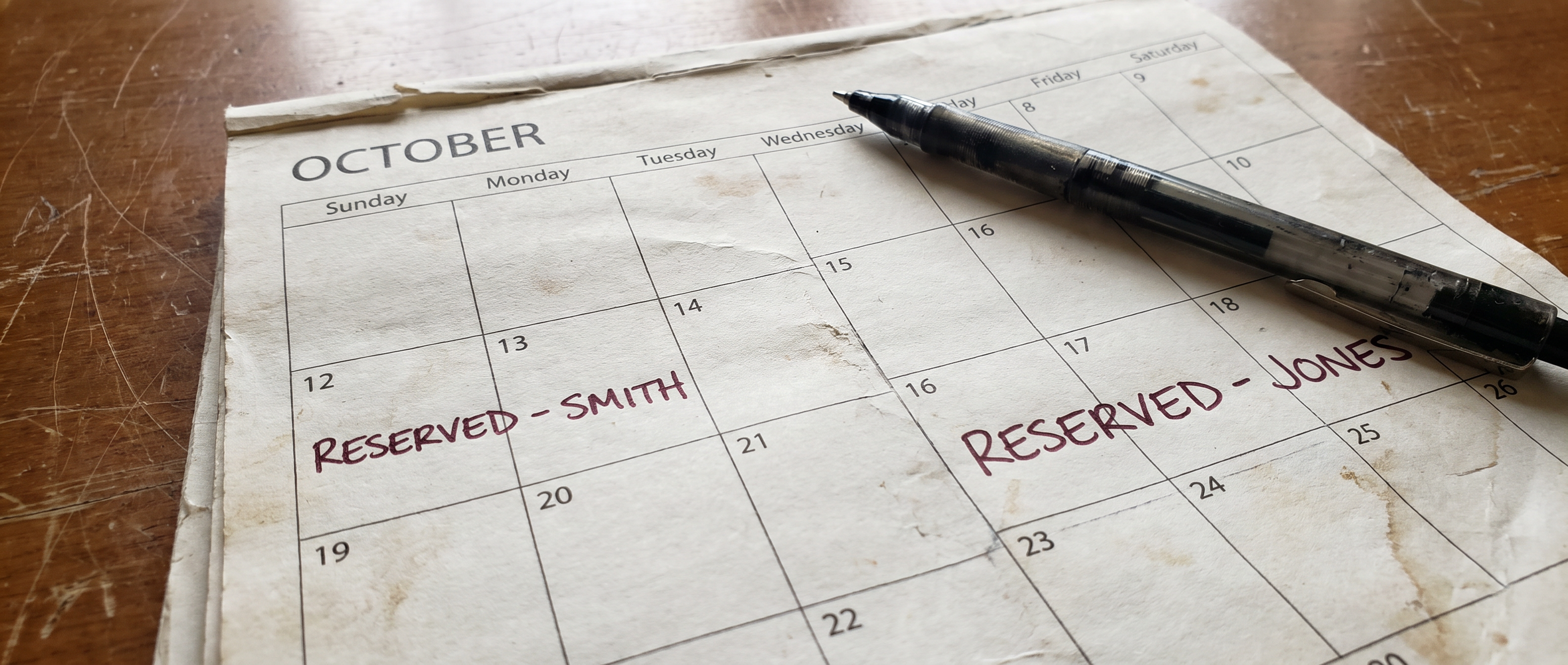
The gap looks like bad luck. It’s usually a rule.
What an orphan night is
Revenue managers use "gap night," "orphan night," and "orphan day" interchangeably. The definition is simple: an unbooked night that falls between two confirmed reservations and is too short to satisfy the normal minimum-stay rule. A checkout on Friday and a check-in on Sunday leaves Saturday as a gap night. A checkout on Sunday and a check-in on Thursday leaves a four-night gap, which a seven-night minimum makes unbookable.
The distinction that matters: a gap night is not an empty night. Empty nights are a demand problem, and AirDNA’s data shows that most unbooked nights in a year actually sit in long stretches of eight nights or more, which is low season, not a calendar glitch. Gap nights are a rules problem. The demand on either side of them has already been proven by the bookings that bracket them.
How gap nights get made
Three settings create most of them.
A fixed minimum stay. This is the big one. A three-night minimum makes every one- and two-night gap unbookable. A seven-night minimum makes every gap under a week unbookable. Guests searching for those dates never see the home, and because a filtered-out listing produces no inquiry, the owner never learns a guest wanted it.
Fixed check-in days. A Saturday-only check-in rule means a Thursday checkout strands Thursday and Friday every single time. On the Maine coast in July, where weekly Saturday-to-Saturday stays are the norm, that’s fine, because the next guest is arriving Saturday anyway. In June and September it strands two nights a week.
Owner blocks placed without looking. An owner stay from Wednesday to Saturday in ski season, placed in the middle of an open week, turns a sellable week into two fragments: Sunday to Tuesday and Saturday night. The same stay placed Sunday to Wednesday, starting the day the weekend guest leaves, strands nothing.
The common thread is that each rule is set once and left alone. AirDNA found that 60% of hosts across the largest U.S. markets use the same minimum stay every night of the year.
What they cost over a season
Take two illustrative homes. The numbers are examples, not drawn from any GetAway property.
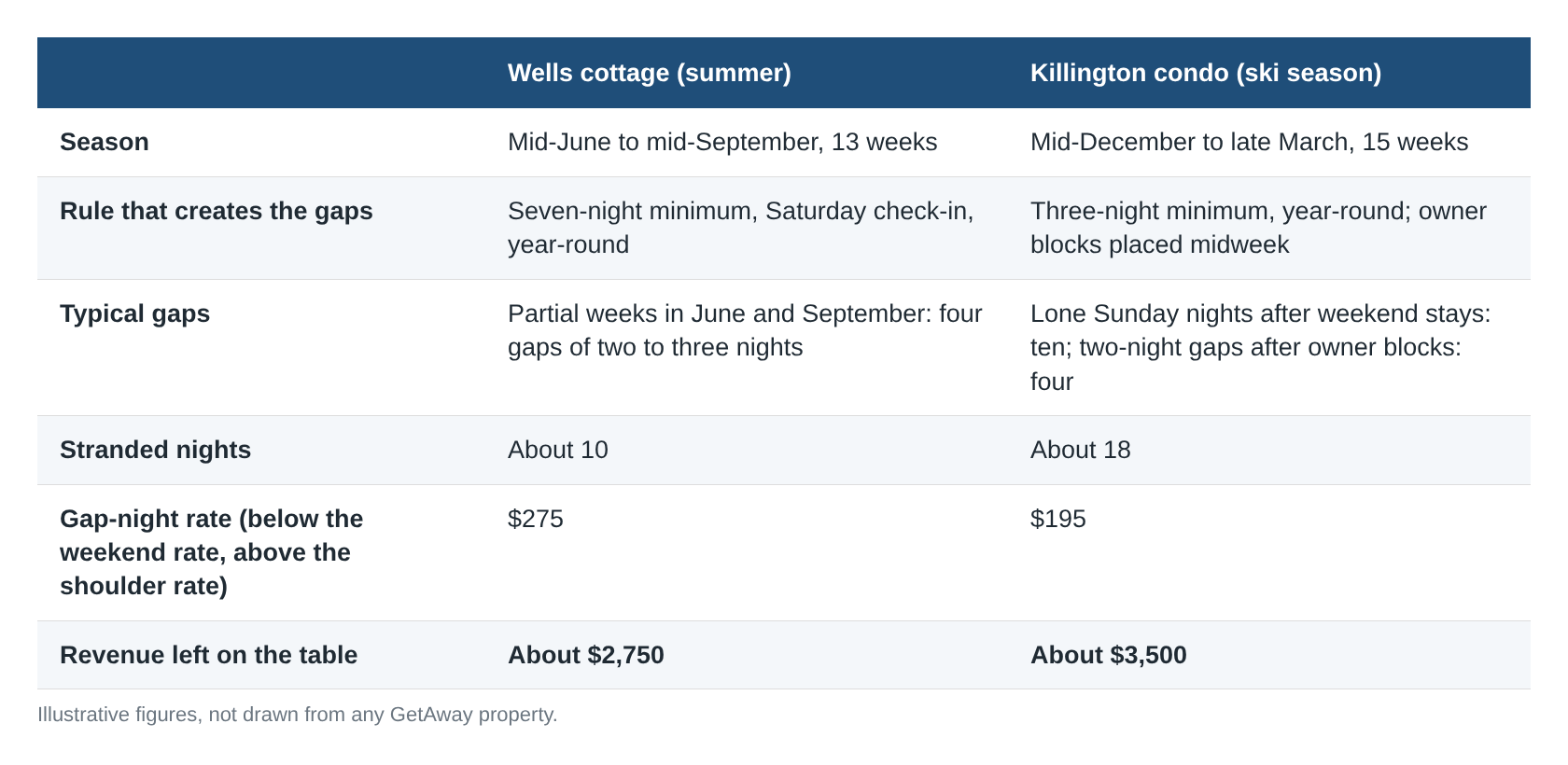
That’s with modest gap rates and no change to the peak weeks. Pricing-tool vendors estimate gap nights cost owners anywhere from 5% to 15% of potential annual revenue depending on booking patterns and minimum-stay settings. The exact number matters less than the direction: these are nights the demand already paid for, and the calendar refused the money.
Filling them without inviting one-nighters
A one-night stay in a four-bedroom house is not automatically a good idea. Two three-night bookings cost one more turnover than one six-night booking for the same revenue, and a one-night guest brings a full turnover for a single night’s rate. So the fix is targeted, not a policy change:
Let the minimum stay drop to fit the gap, and only the gap. If two nights are open between bookings, the minimum for those two nights becomes two. The rest of the calendar keeps its normal rule. Modern pricing tools detect the gap and change the minimum automatically; a manager checks that it happened.
Price the gap for the turnover. A gap night carries a full cleaning for a short stay. The rate should sit between the shoulder rate and the weekend rate, high enough to cover the turnover and wear, low enough to sell. A small discount for the gap is common; a fire sale isn’t necessary, because the guest searching those exact dates has few options.
Open the check-in day. Outside the weeks where a Saturday rule serves a purpose, allow check-in any day of the week.
Keep the long-stay rules on the long-stay weeks. Holiday weeks in Killington and the July and August weeks on the coast keep their minimums. Breaking Presidents’ Week into two-night fragments to fill a gap costs more than the gap was worth.
Watch the orphans that discounts can’t fix. A single Sunday night between two ski weekends will sell to a midweek pass holder. A single Sunday night in April might not sell at any price. Treat those as shoulder-season nights and price the whole stretch, not the night.

On the coast, the gaps live in June and September.
Maine weeks and Killington weekends: the local layer
Ogunquit’s seven-day minimum. The town sets a seven-day minimum stay on weekly private home rentals, so Ogunquit homes can’t fill a three-night gap at all. The lever there is different: pricing the June and September weeks to sell as whole weeks, and placing owner weeks at the edges of the season rather than in the middle of it. Our Ogunquit owner program is built around that rule.
York and Wells. Neither town imposes a weekly minimum, so a Saturday-only check-in rule in a York or Wells home is an owner’s choice, not a town requirement. In July and August the weekly rhythm holds on its own. In June and September, opening the check-in day and letting minimums drop to fit gaps is where a York or Wells cottage picks up the extra nights.
Killington and Okemo. The lone Sunday night is the signature gap: the weekend guest leaves Sunday morning and the next weekend guest arrives Friday. A three-night minimum on Fridays keeps the weekends whole; a lower minimum from Sunday to Wednesday lets midweek skiers and remote workers take the Sunday. Holiday weeks (Christmas, Presidents’ Week, the Killington Cup weekend) keep their longer minimums regardless. Our Killington owner program prices those windows separately.
Placing owner stays so they don’t strand nights
Your own weeks are the one calendar rule you control completely, and the easiest to get wrong. Three habits:
Start your stay the day a guest leaves. Check in on their checkout day and the turnover does double duty.
In peak season, prefer Sunday to Wednesday or Sunday to Thursday. Those are the nights least likely to sell at full rate, and blocking them keeps the weekends available.
Avoid Wednesday-to-Saturday blocks. They strand the nights on both sides.
Blocks placed through the owner portal show as unavailable everywhere the home is listed, and the local team sees them next to guest arrivals so housekeeping is scheduled around your stay, not around a gap.
What a revenue manager automates
GetAway’s revenue managers combine dynamic pricing technology with experience, and gap handling is one of the places the technology earns its keep: it scans every calendar continuously, detects a gap the moment a booking creates one, applies the shorter minimum and the gap rate, and reverts when the gap fills. AirDNA’s October 2026 analysis found that hosts using static pricing book about two fewer nights a month than hosts using algorithmic pricing, a difference it valued at more than $6,000 a year. Gap nights are a large share of that difference, because they’re the easiest nights to recover: the demand is already there, and all the calendar has to do is let the booking happen. For more on how the pricing works, see dynamic pricing with an expert behind the wheel.
Stop refusing the money
A calendar full of two-night holes isn’t unlucky. It’s running rules that were set once and never revisited. Let the minimum stay fit the gap, price the gap for the turnover, open the check-in day where the town doesn’t require one, and put your own weeks where they strand the least. The demand was already there.
Get a free rental projection to see what your Vermont or Maine home should earn with the gaps filled.
Frequently asked questions
What’s the difference between a gap night and an empty night?
A gap night sits between two confirmed bookings and is too short for the minimum stay; the demand around it is proven. An empty night sits in a longer unbooked stretch, usually in low season, and reflects demand rather than rules. Discounting a gap night works. Discounting an empty night in April rarely does; that stretch needs seasonal pricing.
Should I lower my minimum stay to one night?
Not across the board. A one-night minimum everywhere invites one-night stays on nights that would have sold as part of a longer booking, and each one carries a full turnover. The better approach drops the minimum only for the specific gap and keeps the normal rule everywhere else.
Why not just block the gap nights for maintenance?
Sometimes that’s the right call, and a manager will use a gap for a hot tub service or a deep clean. But doing it by default throws away sellable nights. The decision should be made gap by gap, with the maintenance calendar in view.
Does the seven-day rule in Ogunquit apply to York and Wells?
No. Ogunquit’s seven-day minimum applies to weekly private home rentals in Ogunquit. York and Wells don’t impose a weekly minimum, so check-in days and minimum stays there are the owner’s and manager’s choice. Town rules change, so confirm the current requirement before setting a policy around it.
How do owner blocks create gap nights?
A block placed in the middle of an open week splits the week into fragments too short to book. A stay from Wednesday to Saturday in ski season strands Sunday through Tuesday on one side and Saturday night on the other. Starting the stay on a guest’s checkout day, or placing it Sunday to Wednesday, avoids most of it.
Can I see gap nights in my owner reporting?
You can see every booking, every block, and every open night on the calendar in the owner portal, alongside revenue and occupancy. If the Sundays and Mondays between weekend stays start showing as booked, the gap rules are doing their job.